The Congress shall have Power . . . To provide and maintain a Navy.
—US Constitution1
For whosoever commands the Sea, Commands the Trade: whosoever Commands the Trade of the world: Commands the Riches of the world and consequently the world it selfe.2
—Sir Walter Raleigh
America has been and always will be a maritime nation. Even in the early postrevolutionary days of 1801, American sailors were sent to far-off places like the coast of North Africa to protect US trade from Barbary predation.3 Later in the 19th century and into the 20th, Alfred Thayer Mahan preached the gospel of navalism, and Theodore Roosevelt received it. While some might argue that more than a century after Mahan and Roosevelt, the air, space, and cyber domains have displaced the sea, this is not entirely true. Indeed, the sea domain will remain relevant so long as maritime trade is central to the US economy.
By some estimates, about 27 percent of the US gross domestic product (GDP) is tied to international trade (exports and imports), with about 70 percent of this trade’s volume moving by sea.4 In 2022, the value of sea trade to and from the US was about $2.2 trillion, or roughly 8.5 percent of the $25.5 trillion US GDP.5 Losing the critical sea routes this trade flows through could plunge the United States into an economic depression of intensity not seen since the 1930s. Thus, the seas will continue to play an outsized role in the United States’ security considerations even if the US adopts more protectionist measures; there will still be a need to protect maritime exports.
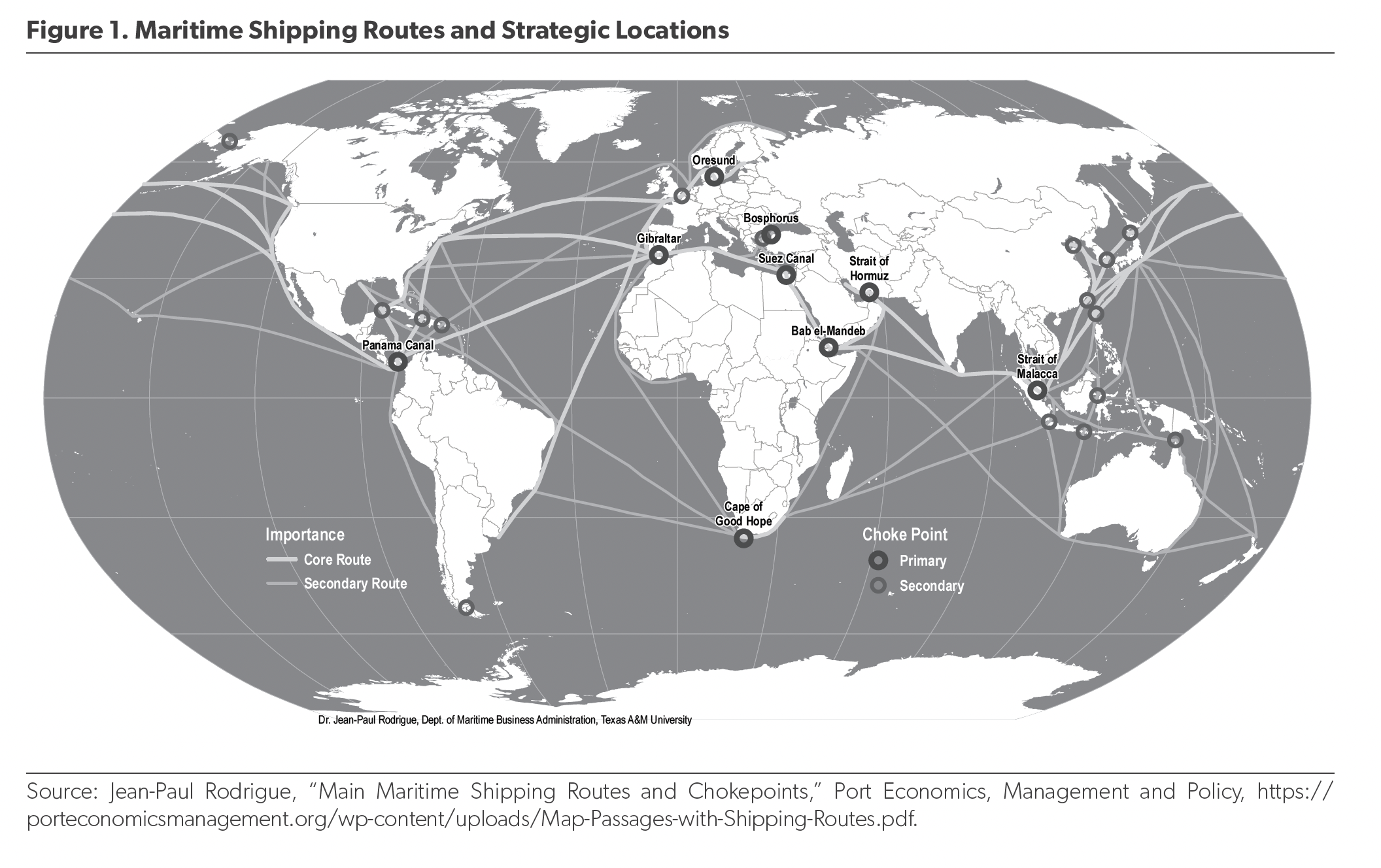
Although most conflicts in the world today (and in the future) are fought on land, maritime capabilities are essential for the prosperity of the global economy, which makes possessing such capabilities all the more important during war.6 It is possible that a resurgent Russia could harass shipping off the Alaskan coast or in the Atlantic just as Iran and its proxies are currently harassing trade along the sea routes of the Middle East and while Russia’s Chinese “friends without limits” threaten trade along the sea routes of the Pacific, specifically near Taiwan and its adjacent waters.7 As Figure 1 shows, nine primary choke points and 15 secondary choke points on sea routes could, if threatened, bring the global economy to a halt. Only a strong and capable US Navy can keep these critical lanes free and open.
These choke points are clustered in three potential theaters. The primary challenge facing the US Navy today is that it possesses neither the capacity nor the capability to be active in those three theaters simultaneously.8 Sized for one short war, the Navy lacks the depth in munitions, ships, and personnel for sustained combat operations.9
To make matters worse, our nation’s shipyards may be permanently broken and unable to produce the warships necessary to rebuild the fleet.10 The Navy is still using the same shipyards and concepts honed during World War II and the Cold War. It is sailing in circles trying to find a way out of its current dilemma. We could continue down the same path, but as was once said, the definition of insanity is doing the same thing repeatedly while expecting different results. It is time for a 180-degree pivot toward an affordable, efficient, effective path ahead.
This would be a 180-degree pivot away from the Navy’s current taste for exquisite, large, and costly platforms and toward a future of mass production and customizability. It would manifest itself as a full embrace of autonomy in the air, a massive embrace of autonomy at sea, and a revolutionary cultural change to embrace software programmers as warfighters, who would replace aviators as the key partners for sailors. This pivot would give the US the Navy it needs at a price it can afford.
Most militaries cannot fundamentally change without large-scale failure, yet that would be a national and global catastrophe. A large-scale Navy failure would decimate the US economy and the global economy along with it.11 The US Navy has been the backbone of the global trading systems, and today’s globally distributed supply chains will crumble if it fails. We don’t have to look too far back to recall the COVID-19 semiconductor shortage, which affected any product that used microchips and shut down the auto sector among many others.12 That shortage would pale in comparison to the results of a large-scale Naval failure, which would create a multiyear rather than a multi-month economic crisis.13
Fixing our broken Navy is therefore nonnegotiable, and, fortunately, the change needed is achievable and affordable. The US Congress, which has the constitutional authority to “provide and maintain a Navy,” must furnish the funding, flexibility, and moral support required to make this fix.14
Why a Navy Is Needed
It’s expensive. We recognize that. But it’s less expensive than fighting a war with somebody who thought that we were weak enough that they could take advantage.
—Former Secretary of Defense James Mattis15
History teaches us that weakness invites aggression and that preventing war is cheaper than waging it. The United States is a global country. Our trade flows and other interests span the globe, and we need a strong Navy to project power wherever those interests lie. A strong Navy provides not only for our security and prosperity but for that of our allies and even many non-allies as well.
In the security domain, the Navy fulfills three key roles that cannot be replicated, each of which enables the president to fulfill their constitutional role as the commander in chief. First, the Navy is essential for deterring potential adversaries and defending the nation against threats. It provides a strategic and operational deterrent by ensuring our adversaries know that they are under constant threat. Second, the Navy maintains a global presence, which allows it to respond quickly to international crises and conflicts, enabling the president to stabilize crises and prevent wars. Third, the Navy plays a significant role in humanitarian assistance and disaster relief operations, bolstering US credibility on the world stage.
As for prosperity, the Navy’s protection of sea-lanes is vital for the global economy.16 By ensuring the free flow of goods and resources, the Navy supports international trade and economic stability. Not only do we benefit from the classic Ricardian efficiencies of trade, but we also wield enormous economic influence globally in large part due to our efforts to sustain the global economic system.
Finally, in terms of the state of the world, the United States has shifted over the past three decades from leading a post–Cold War order based on free trade and democracy to a three-theater battle with China, Iran, and Russia who each advance authoritarianism and seek to dominate their respective regions. In 2015, American Enterprise Institute scholars wrote about this in their seminal report To Rebuild America’s Military.17 Despite their prescience, their warnings and recommendations went unheeded, enabling a decade-long buildup of adversarial forces meant to threaten America’s economic prosperity and national security. Only a strong Navy will allow us to compete and win in this new era.
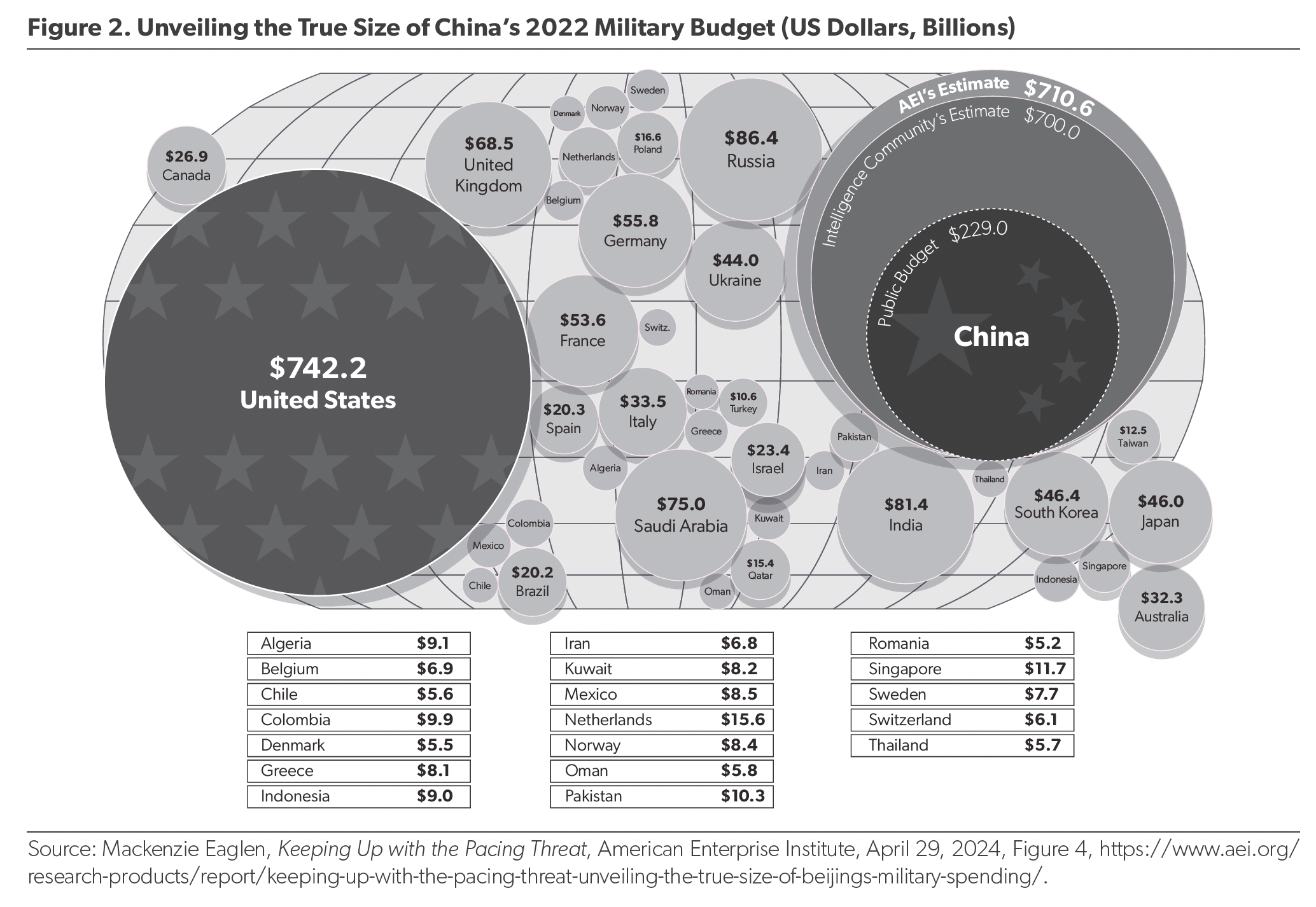
China is spending more money than most realize in support of its military ambitions (Figure 2), funding a massive expansion and modernization of its navy, the People’s Liberation Army Navy (PLAN).18 Since it surpassed the US Navy in fleet size around 2020, the PLAN has become the world’s largest navy by number of vessels, comprising over 370 major ships including surface combatants, submarines, and auxiliary vessels.19 This count is expected to grow to 435 ships by 2030, underscoring China’s strategic push for dominance, especially in its “near seas” region, which includes the East and South China Seas. The PLAN’s expansion is bolstered by China’s immense shipbuilding capacity, which outpaces the US by a significant margin.20 This advantage allows China to sustain a rapid build rate of large warships and smaller vessels like frigates and corvettes. China is simultaneously developing and fielding modern technologies such as hypersonic missiles and advanced anti-ship systems, which pose growing challenges for US and allied forces operating in the Indo-Pacific.21
More important than China’s naval rise is the rapid integration of emerging technologies underway by China and other adversaries including Iran and Russia.22 Advanced weapons and autonomous systems that are produced at scale around the world essentially enable any adversary, large or small, to challenge and perhaps defeat the US Navy, if not today, then in a few years as these technologies further mature.23
The advent of unmanned systems, often powered by artificial intelligence, is already providing relatively unsophisticated and poorly funded enemy forces, such as the Houthis, with a virtually unlimited supply of cheap, smart, unmanned, and possibly autonomous systems that are challenging the Navy in new ways.24
Naval drones are maturing with extraordinary speed. Surface and subsurface unmanned systems, such as the Houthis’ Toofan-1, are revolutionizing surveillance, reconnaissance, and strike capabilities.25 These drones are cost-effective and able to operate in high-risk zones without endangering personnel, and they can conduct precision strikes. In conflicts, drone swarms have proven capable of bypassing traditional defenses, marking a shift from a reliance on larger, manned ships to a more versatile, agile naval force. The relative ease of developing these capabilities will enable many previously unconsidered groups and nations to challenge and perhaps gain the upper hand on the US Navy.26
We must also consider that cyber and electronic warfare are now here. New electronic warfare capabilities, available to just about any nation or terrorist group, will enable the United States’ adversaries to disrupt the Navy’s sensors, communications, and targeting—their entire information system.27
Finally, directed energy and advanced weapons are on the near-term horizon.28 High-energy lasers and hypersonic missiles are some of the cutting-edge weaponries that China and Russia are developing. This is while US Navy leaders operating against the Houthis in the Red Sea have complained that the current Navy laser weapons are relatively ineffective and that having to fire multimillion-dollar missiles at multi-thousand-dollar drones is not efficient or sustainable. Only with larger investments and full-throated all-of-industry efforts will the Navy get the greater accuracy and power this unlimited “ammunition” could offer. Therefore, the Navy should commit to a much larger scale program of building operational prototypes and quickly iterating to put these crucial systems in the hands of warfighters.
The technological revolution that originated in the United States is enabling practically every state and terrorist group in the world to build smart weapons at scale, stealing a competitive advantage the United States once held. Not only has this technology proliferated, but since these nations and groups do not have older, less capable ships or planes, they are able to leapfrog the US Navy, which is tied down to its expensive and creaking legacy programs.
The era of uncontested US Naval primacy over the seas has come to a close. Our adversaries have shown not only that they possess dangerous capabilities but that they are willing to use them to disrupt and destroy our country’s abiding interest in safeguarding the global economic system.
Why the Current Navy Is Broken
In the post–Cold War period, the Navy made two fatal mistakes. First, it prioritized building aircraft over ships. From 1991 to 2015, the Navy spent around $258 billion on aviation procurement, compared with $254.6 billion on ship procurement, creating a lost generation of 25 years for shipbuilding.29 In the past decade, however, the Navy has wisely reversed this ratio by spending about $60 billion more on shipbuilding than on aircraft. Those gains, while in the right direction, are less impressive as they have been largely eaten up by increased shipyard costs rather than increased production of ships.
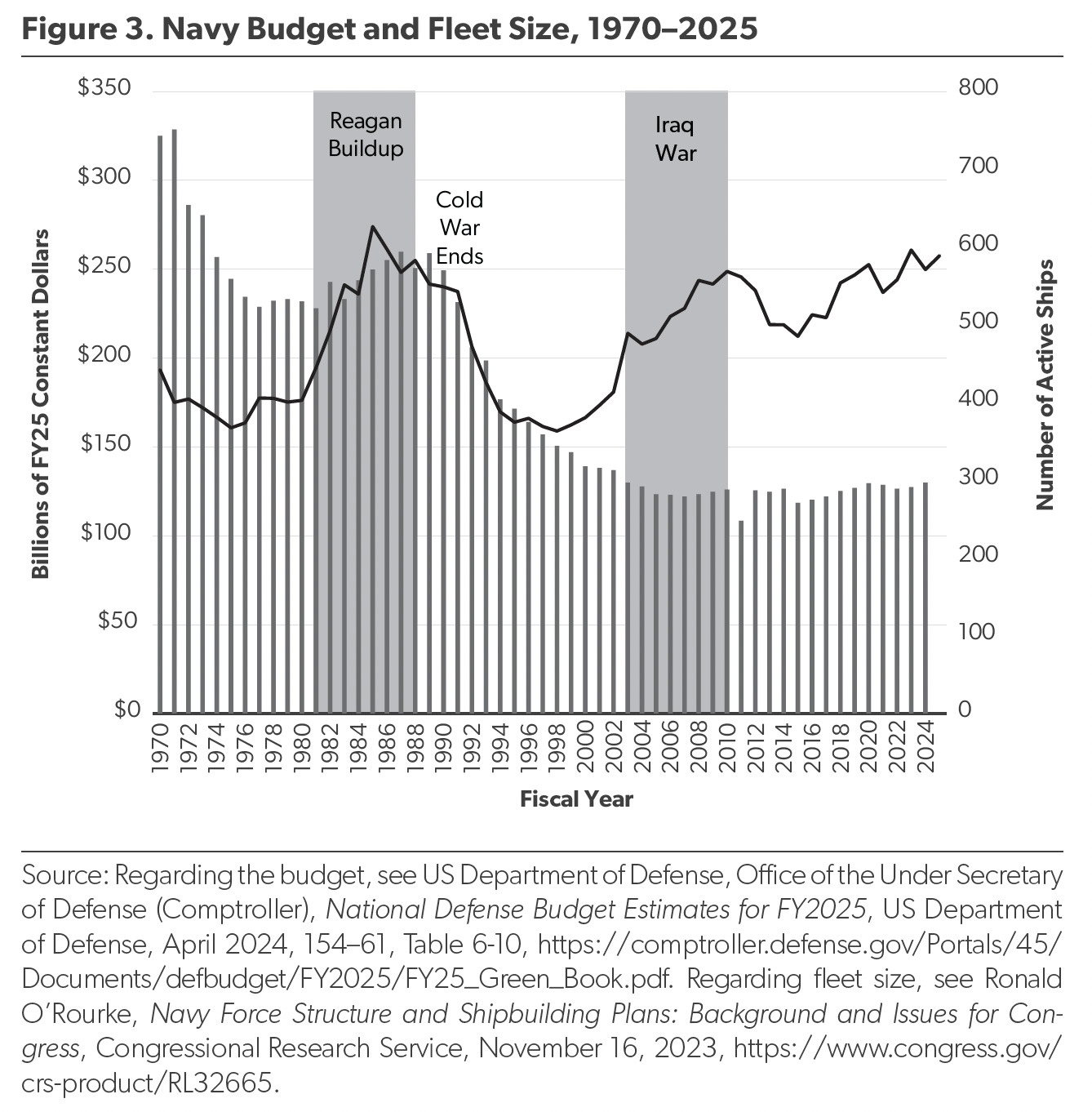
This 25-year period, which was marked by the defense peace dividend (1991–2000), the global war on terror (2001–12), and budget sequestration (2013–16) saw the Navy cannibalize itself by underinvesting in everything while maintaining an unsustainable can-do operational tempo. The results are stark, with the Navy’s fleet size ever shrinking while its budget is growing.30 The post–Cold War divergence between the budget trend and the fleet size trend can be observed in Figure 3.
The Navy has essentially rotted in place since the 1990s, while our adversaries have adopted American-origin technologies to build advanced naval capabilities at scale, jeopardizing America’s security and prosperity. Decades of continuous budget cuts, failed modernization efforts, and maintenance backlogs have left the Navy struggling to meet its global demands.31 The fleet is not large enough to handle day-to-day operations safely, and repeated deployments have exacerbated maintenance issues. Additionally, increased maintenance delays and parts shortages have forced crews to cannibalize parts for repairs.32
The Navy has insurmountable ship maintenance and readiness issues while it is in the middle of a procurement death spiral in which the unit cost of new weapons outpaces defense budgets.33 Many vessels are unable to undergo needed maintenance due to overcrowded shipyards and outdated infrastructure, creating a backlog that has delayed deployment schedules. The result has been low ship and aircraft readiness rates and numerous vessels kept “in a non-deployable state.”34
The Navy’s fleet is rapidly aging, driven by its attempts to build exquisite ships and planes that may be better fit for the wars of the past than those of the present and future. This conundrum is leading the Navy to extend the usage of its platforms long beyond their expected service lives, causing more breakdowns and increasing maintenance costs.35 These heightened maintenance costs result in fewer dollars available to procure more ships, further increasing upkeep costs as old ships used past their prime deteriorate ever more quickly. The cycle cannot fix itself.
Even though the Navy has been buying fewer and fewer ships, the cost of each ship keeps increasing. The increased costs for ships and aircraft mean that the Navy can buy fewer, which drives up costs as research, development, test, and evaluation spending is distributed over fewer units. Even with all the money it could receive at this point and into the future, America may now lack the industrial base it would need to build “new” World War II–vintage, scalable naval ships.
The Navy, like the other services, is hindered by personnel shortages.36 The Navy often has difficulty maintaining fully staffed crews, especially on submarines and certain surface vessels, affecting operational capacity and increasing the workload on current personnel. Driven by a high operational tempo, the Navy continues to extend deployments without sufficient downtime, leading to burnout among sailors and, even worse, crews that are not properly trained. Coupled with high-profile scandals and ethical breaches among Navy leadership and you have a situation in which the Navy’s morale and the public’s trust in its Navy have eroded.37
We can see some of the results of the broader degradation in fatal accidents, which are the result of inadequate training, particularly in basic seamanship and navigation. Many collisions such as those involving the USS Fitzgerald and USS John S. McCain in 2017 attest to this degradation.38 These accidents and other incidents that have been well-documented, including collisions, fires, and breakdowns, indicate systemic problems. All this is driven by an outdated doctrine and strategic vision.39
Finally, as warfare shifts toward software-defined weapons, the Navy has struggled to keep up, making it vulnerable to cyberattacks.40 Several breaches have compromised critical information about naval plans and ship designs.41 Most importantly, however, the Navy is not prepared to operate offensively with cyber, software, and electromagnetic spectrum capabilities.
The cumulative effect of these issues will lead many to conclude that the Navy’s effectiveness is compromised. While individual reforms, additional funding, or modernized practices might address certain problems, the scale of these challenges suggests that more extensive structural and cultural changes are necessary.
How to Fix the Navy
If it pivots now, all is not lost for the United States and its Navy. This pivot will be difficult, but so long as the Navy receives the resources, flexibility, and support it needs, it can regain its rule of the waves over the next decade. The only solution may be a 180-degree pivot away from exquisite, large, and costly platforms and toward a future of mass production and mass customization. As mentioned above, this would manifest itself as a full embrace of autonomy in the air, a massive embrace of autonomy at sea, and a revolutionary culture change to embrace software programmers as warfighters that will displace aviators as the key partners for sailors. This change will enable the nation to have the Navy that it needs at a price that it can afford.
The guiding philosophy of this naval transformation should focus on autonomous systems and AI, cyber and electronic warfare, and distributed lethality.42
Autonomous naval systems integrated with AI are already here, but the Navy is still debating the adoption of these new technologies across the service, much as sailors debated moving from coal-fired engines to oil-fired engines a century ago.43 Unmanned surface and subsurface ships are at a similar development stage as unmanned aircraft were a decade ago. However, the maturity curve and adoption of drone ships is going to proceed much more rapidly than it has for comparable aircraft. This is for two simple reasons: AI’s rapid development is providing a springboard that aerial drones did not have a decade ago, and sea-drone production will benefit from the lessons learned from aerial drones.
To conduct cyber and electronic warfare at scale, the Navy must develop specialized skill sets in its human capital. For instance, sailors who maintain the engine rooms on existing ships will now need to write software in real time. Additionally, as we have seen in Ukraine, “pilots” flying aerial drones require skills in rewriting software in response to the adversary’s tactical use of electronic warfare. Since many aerial drones can fly themselves with AI, coding skills will be the most important attribute for future aviators. Until the Navy adopts this core task of developing thousands of its people with the necessary skill sets, it will be unable to transition to these new technologies.
While manned vessels will never fully go away, the Navy should pivot away from its long-held 355 ship target—which is proving unrealistic from a production standpoint anyway—and instead plan for tens of thousands of mostly smaller and relatively autonomous vessels, many of which will be tailored, specialized platforms for specific mission sets. Unlike the flawed Littoral Combat Ship or the Joint Strike Fighter, which are built to be jacks-of-all-trades but masters of none, the Navy must learn to build tailored and specialized platforms for discrete and specific mission sets. It must be able to mass customize production in near-real time and at scale. With the White House announcing a wholesale overhaul of shipbuilding, this new direction will ensure that the United States becomes the global leader for producing these new ships of the future, rather than investing in rebuilding the shipyards of the past.
With these as its guiding principles, the Navy should change its ships, submarines, planes, munitions, and people. Simply put, the Navy must change everything. Of course, this will not happen overnight, and it is likely that the current inventory of around 280 naval vessels will be around for decades to come.
Still, integrating new technologies and selectively replacing some ships will be necessary, and other systems can be replaced much more rapidly. To begin revolutionizing its force, the Navy should prioritize autonomous seaborne vessels to support its manned sea fleet, eliminate its manned aviation fleet as quickly as possible in favor of several hundred thousand aerial drones, and create new industrial and software production capabilities to produce at scale in near-real time.
The Navy must also miniaturize its surface fleet. Swarms of smaller, modular vessels like patrol boats and gunboats should be deployed near coastlines, offering a deterrent and fast-response force without a major shipyard overhaul. These ships are cheaper to produce and deploy, particularly in contested or crowded areas. Thousands of drones, like the Orca, a large autonomous submarine designed for intelligence and mine hunting currently under development, could provide a persistent presence in contested waters.44
In addition, the era of manned Naval aircraft should end. Manned aircraft necessitate large aircraft carriers, which in turn require other ships for protection. Moving away from large ships to smaller, autonomous vessels is crucial. This shift will allow the Navy to leverage massive fleets of small and autonomous surface and subsurface drones, acting as force multipliers for surveillance, reconnaissance, and logistics support.
Cancel F/A-XX, the Navy’s future sixth-generation air superiority fighter, and invest that money into unmanned systems. Large numbers of aerial drones can enhance naval operations with intelligence, surveillance, and reconnaissance capabilities, extending the Navy’s eyes and ears without endangering its manned sea vessels. Combat operations in the Middle East and Europe show that swarming drones, specialized drones, and cheap, attritable drones that function as munitions dramatically reshape the battlefield.45 While longer ranges will require larger unmanned systems due to weight and power, systems designed to operate without a pilot will still be smaller than manned fighters.
The Navy’s nuclear submarine fleet is America’s crown jewel, but recent accidents and an inability to rapidly manufacture and repair the fleet are leading to its decline.46 Some may argue that if the Navy just spent more money, the production constraints would disappear. Another alternative is for the Navy to quit while it is ahead and find a new crown jewel for its portfolio. Oftentimes, large institutions fail to disrupt themselves when they are on top, so they wait for some other organization to knock them off their perch, akin to the transition between wooden ships and steel in the 1880s or the rise of tank warfare between World War I and World War II. To avoid being displaced, the Navy must rise to the occasion and develop the next generation of subsurface weapons systems that are affordable and scalable. Underwater autonomous sea vessels can be an effective partner to the Navy’s submarine fleet by providing the enemy with multiple subsea challenges. These vessels can also make the submarine fleet more risk acceptant, as they could use autonomous vessels for particularly dangerous missions.
With advances in secure and rapid communication, a networked fleet of small ships and drones could be as effective as a smaller number of large vessels. Distributed lethality allows each unit to play a role in the fleet’s offensive and defensive capabilities, making 35,000 interconnected nodes a powerful and resilient force.47 This autonomous and miniaturized fleet would be serviced by manned ships that operate like aircraft carriers today but are much smaller in size and signature.
The Navy will need to build on and leverage existing technology and build human capital to take the lead in building future-use technology for 3D printing and rapid aerial drone building and shipbuilding for on-the-fly fleet and aircraft expansion.48 Granted that this is unproven and will be difficult, portable shipbuilding facilities could add temporary ships to the fleet quickly and efficiently. This approach could be crucial to replace losses or adjust to shifting demands in wartime. Additionally, modular vessels, like floating bases or repair ships, could act as mother ships that support or refit the smaller vessels and drones, providing adaptability and resilience in the fleet without each platform requiring its own heavy support structure.
As the Navy shifts toward more AI-driven, cyber-integrated, and distributed operations, its sailors and officers must adapt to new technologies and tactics. This will require substantial investment in education and training programs and an updating of naval doctrine to reflect new warfare concepts. Traditional career paths in large ship commands may give way to positions focused on managing autonomous systems or overseeing complex networks of smaller platforms or even in writing software code.
Finally, the Navy will need pre-positioned, modular, and “just-in-case” fleets, such as large logistic stocks of unmanned assets, that operate much like the Army’s pre-positioned equipment fleet. In times of crisis, the Navy could rapidly deploy these assets to act as reconnaissance, supply, or fire support.
This type of scale would demand a shift from a traditionally centralized and hierarchical Navy to a distributed, data-centric force. With tens of thousands of ships (many being drones or autonomous craft), the Navy would prioritize information dominance, strategic autonomy, and overwhelming the adversary with a difficult-to-combat number of small, capable assets.
Challenges to This Pivot
As noted in The Innovator’s Dilemma, changes of this magnitude are difficult because new technologies often cause great organizations to fail.49 It is frequently the case that great militaries change only after brutal wartime losses, exactly the outcome that the United States must avoid. To make this 180-degree pivot, the Navy must overcome three challenges: bureaucratic and institutional resistance, accelerating technological innovation, and obtaining sufficient financial resources.
Like any large bureaucracy, the Navy has historically resisted significant change due to entrenched interests. Many in the Navy still favor large, traditional platforms like aircraft carriers despite calls for more agile, distributed forces.50 Transitioning from exquisite, large, and costly platforms toward a future of mass production and mass customization may require a new generation of Navy leaders.
The Pentagon’s acquisition system is notoriously slow and risk averse.51 The long timelines for fielding new systems due to rigid procurement rules inhibit innovation. Wholesale adoption of the recommendations put forth by the Commission on Planning, Programming, Budgeting, and Execution Reform will be necessary to shift from a 1950s, Soviet-style, centralized acquisition system toward a decentralized acquisition and resourcing system.52 Warfighting commands should have the money and talent to acquire these mass-customized systems for the very near-term tasks that they need to solve.
Overcoming the technological hurdles will be difficult but not impossible. While AI and unmanned systems promise to revolutionize naval operations, developing reliable, secure, and autonomous platforms capable of operating in complex maritime environments is still an evolving goal. Issues such as human-in-the-loop AI kill chains, secure communications, and interoperability between systems can be overcome. Additionally, as the Navy becomes increasingly reliant on autonomous systems, it will have to find a solution to the increased risks of cyberattacks. The Navy must develop its own talent, supplemented by the talent of the civilian sector to overcome these challenges.
Finally, transitioning to alternative propulsion technologies, such as electric propulsion or renewable energy, is technically complex and expensive for large vehicles. However, completing this transition for large numbers of smaller unmanned ships is nevertheless challenging but much easier overall.53
For the United States, enabling the Navy to advance technologies such as AI, additive manufacturing (3D printing), and new propulsion systems might drive commercial innovation and economic growth just as NASA’s programs stimulated growth in the 1960s.54
How to Fund the Pivot
Nothing is more complicated than conducting a 180-degree pivot while supporting global operations amid two wars and facing an aggressive China that could be ready to invade Taiwan in a few years.55 With interest payments on US debt now exceeding spending on our military, some may argue that now is not the time to spend more on defense.56 However, for the reasons outlined above, the US can and must spend more to pivot the Navy, though the service must also do its part by terminating long-cherished programs that will in effect “co-pay” for this pivot.
Senator Roger Wicker, the chair of the Senate Armed Services Committee, recently published a strategic plan for the military that called for defense spending to rise to 5 percent of GDP by the early 2030s.57 As of September 30, 2024, the US GDP stood at $29.35 trillion, which would yield a defense budget for this year of nearly $1.5 trillion, compared with $850 billion for the Pentagon.58 This $500 billion increase, spread over seven years, would yield an increase of $67 billion per year. This request is probably on the upper end of the possible levels of funding. Therefore, let’s assume spending might increase by about one-third of that amount, or $21 billion a year in real terms. Of that $21 billion, given the primacy of the Navy in protecting the sea-lanes and the peacetime economic well-being of the United States, the Navy would receive about one-third of the real growth increase, or about $7 billion a year in additional funding above inflation. For the Navy, this comes out to about 2.5 percent real growth per year in its budget, which is conservatively below the 3–5 percent real growth endorsed by the Commission on the National Defense Strategy’s recent report.59
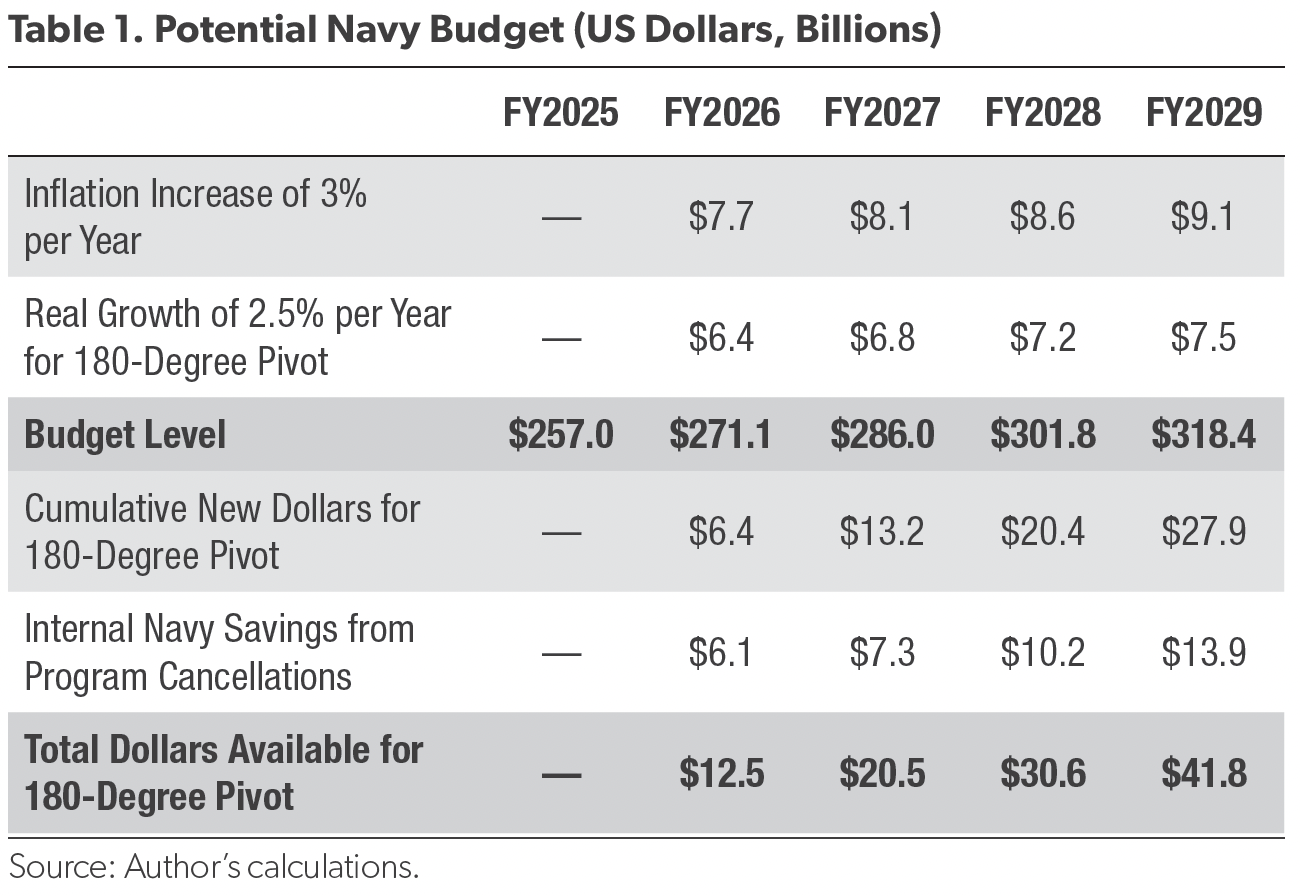
The Navy’s fiscal year (FY) 2025 budget request is around $257 billion, which includes the Navy and the Marine Corps.60 As we look for programmatic procurement reductions to “co-pay” the increased budget, this analysis does not reduce Marine Corps procurement accounts, only Navy accounts. Table 1 depicts how the Navy can have over $41 billion per year by the end of this decade to fund this 180-degree pivot while still preserving operating dollars to operate in today’s high-tempo environment.
Before discussing what the Navy could procure with $42 billion per year by the end of the decade, it is important to lay out a feasible path forward to achieving $14 billion per year in savings over the same time period. To do this, the American Enterprise Institute’s Defense Futures Simulator was used to estimate the quantities and cost savings. The estimates in Table 2 yield the roughly $14 billion per year in savings needed by FY2029.61
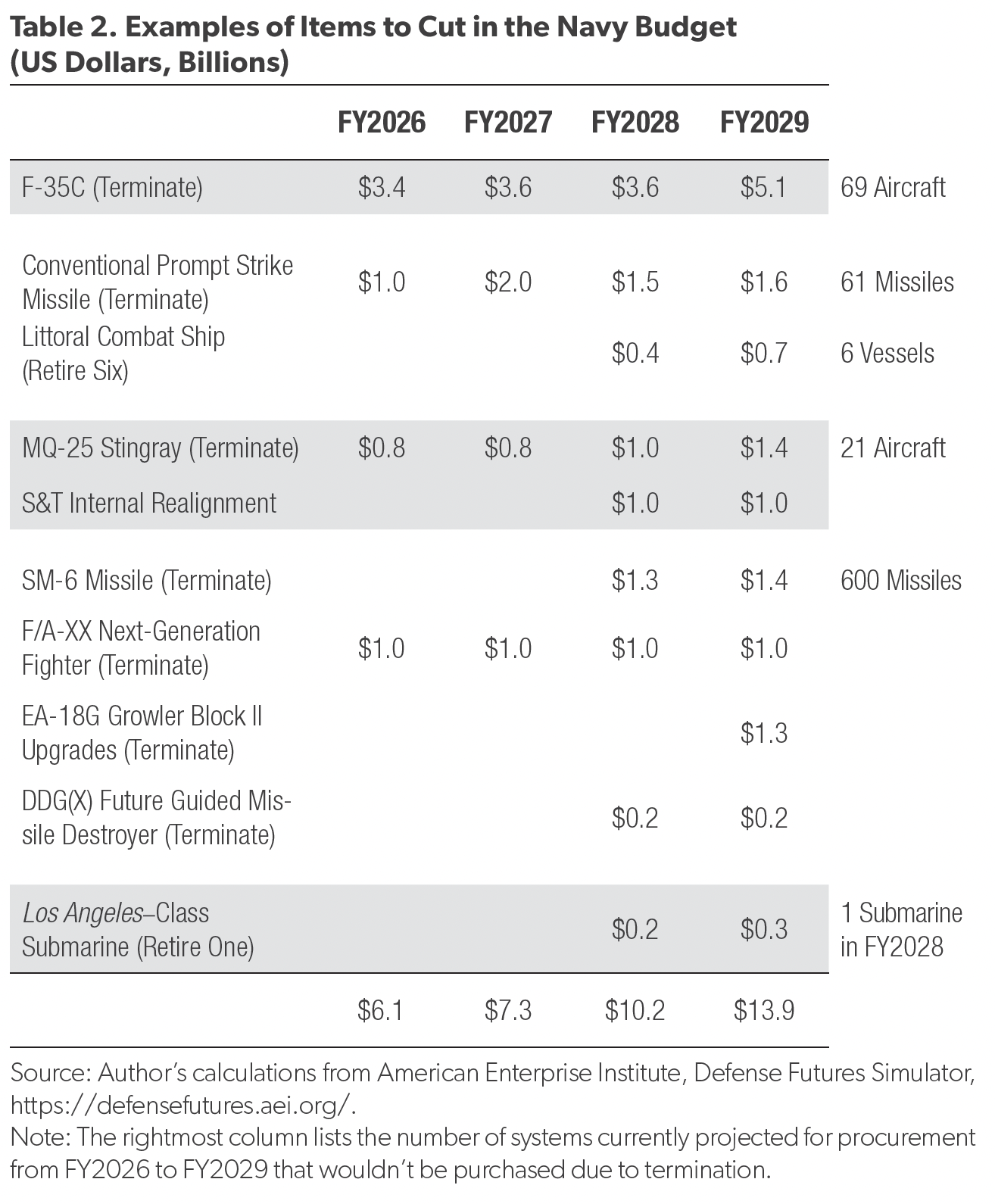
Table 2 shows how altering only 10 Navy programs can generate almost $14 billion per year to fund this 180-degree pivot. The basis for reducing these programs is to reduce programs that are the opposite of the new strategy—in essence, programs that are enormously expensive and produce exquisite, unscalable platforms or weapons. This strategy protects the nuclear submarine fleet from reductions other than retiring early one Los Angeles–class submarine in 2028, by which time the Navy should begin fielding undersea drone vehicles.
To start, the terminations zero in on the F-35C Joint Strike Fighter, which epitomizes the opposite of this 180-degree pivot.62 Similarly, the new Conventional Prompt Strike missile produces only 61 missiles for many billions of dollars, while the Standard Missile–6 (SM-6) will cost $2.7 billion for only 600 missiles, or $4.5 million per missile.63 These reductions call for the early retirement of six Littoral Combat Ships due to its many challenges and high operational costs.64 With a strategy calling for tens of thousands of unmanned vessels, the Navy could take the money from these ships and the MQ-25 aerial refueling drone and use it for systems that can be mass-produced. Rounding out the list of 10 are cuts to three new programs or upgrades, yielding new funds for the pivot rather than reinforcement of the old procurement strategy.
With the additional funding from Congress plus the money from the above terminations, the Navy would have about $10 billion in additional funding each year, resulting in $40 billion per year by FY2029. This approach of adding $10 billion in procurement blocks per year enables the Navy and the new defense industrial base to ramp up production capacity at a sustainable rate. For those who believe this cannot be done at scale, consider that the Ukrainians are producing over one million drones per year and are ramping up to four million per year.65 If Ukraine can essentially scale these small drones at a scale never before imagined, the United States’ industrial might should be able to take the next leap—again, with funding, desire, and the innovative know-how of the private sector.
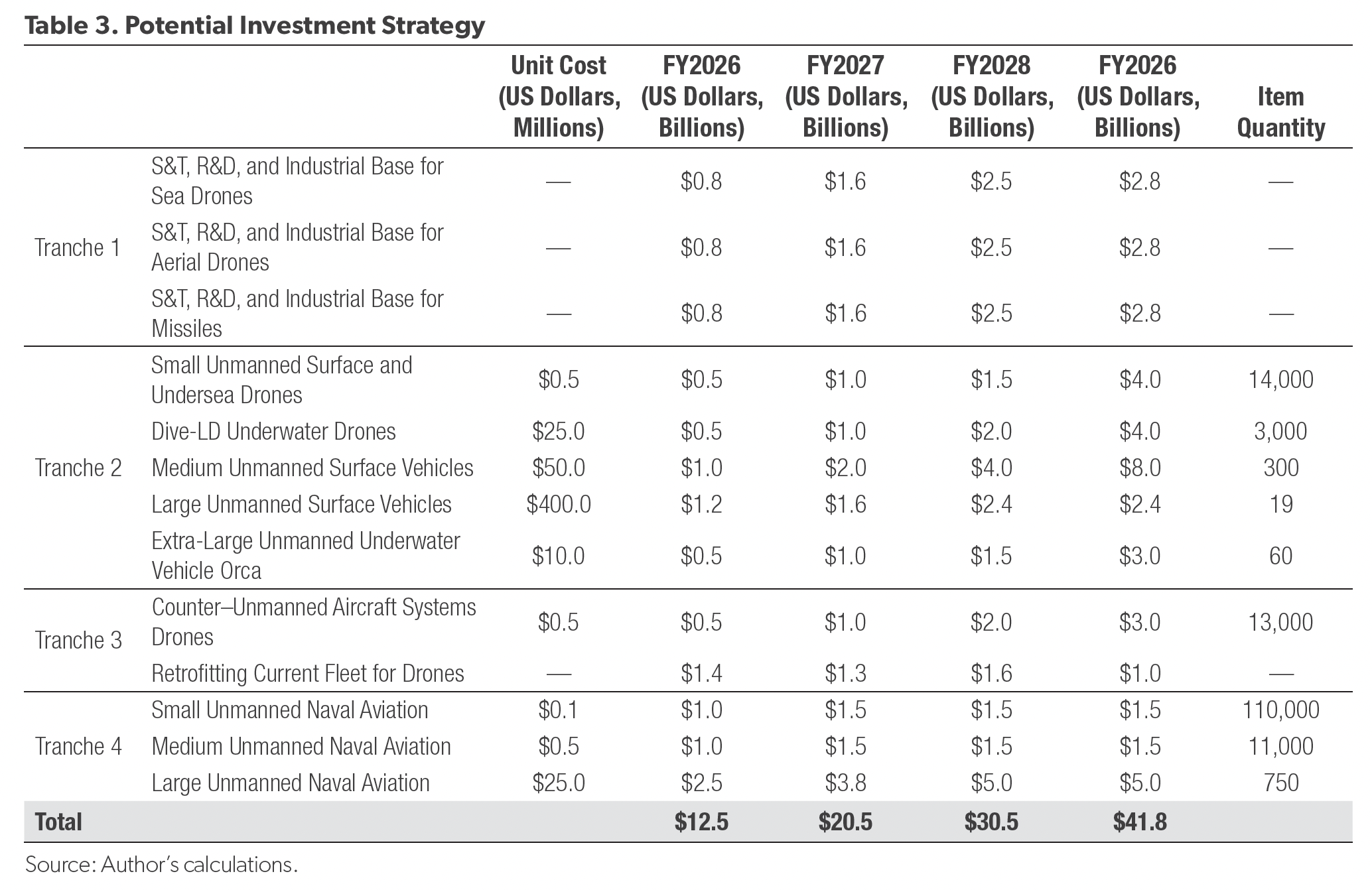
Mass-producing tens of thousands of sea drones and millions of aviation drones for the Navy will not be easy, but it surely will be impossible if not started immediately. Under this funding plan, the Navy would have about $10 billion in additional funding each year, ramping from $10 billion in FY2026 to $40 billion per year in FY2029 and beyond to pay for this pivot. Table 3 is an example of where the money could and should be spent.
Tranche 1 of funding for increased investment should go to constructing the technologies, integrations, and industrial base needed to mass-produce these platforms and weapons. Investments in science and technology (S&T) will enable future technological breakthroughs that will pay off in a decade or more. Investments in research and development (R&D) will be required to take existing commercial technologies and integrate them into military-capable weapons and platforms. Finally, investments in the industrial base will enable the mass production of these drones and missiles. All told, the Navy could invest $8.4 billion per year by FY2029 in developing the technology, integration, and production capacity required for this pivot.
The next batch of funding, Tranche 2, would be directed toward rapidly fielding sea drones at scale. While the Navy would not reach 35,000 sea drones in its inventory by the end of the decade, it could partially get there with over 15,000 sea drones, a start that certainly would enable future growth. This strategy funds a mix of drone sizes and functions, as each drone could be customized for specific mission sets and be considered disposable or attritable. With $21.4 billion per year in funding by FY2029, one can expect much innovation in this sector.
Next, in Tranche 3, the Navy would need to fund an aggressive counter-drone program and a program to retrofit its existing drone fleet. Finally, in Tranche 4 are the air drones, which would receive $8 billion per year by FY2029 and displace the Navy’s manned aviation over time. Overall, with $41 billion per year in funding, this 180-degree pivot for the Navy would be well resourced.
The Path Forward
Our nation is at a strategic crossroads. The challenges outlined in AEI’s 2015 report To Rebuild America’s Military have arrived, and we must make a choice: Either we surrender our primacy on the world stage and our economic future along with it or we invest in and modernize our military. Luckily for America, its commercial sector is leading the world in developing the technologies that will provide our country with the edge it needs. However, those technologies will require, albeit in relatively small amounts, time and money to make them militarily capable. Right now, our adversaries are stealing this technology and militarizing it against us. This trend must be reversed.
While not the only service requiring critical investments, the Navy is perhaps the most important because of its utility in both fighting wars and safeguarding global maritime trade. The Navy has been hollowed out after 30 years of underfunding and is now likely incapable of conducting even one long-duration war, never mind keeping the peace and fighting in three theaters.
For less than $28 billion in increased real spending per year, the Navy can achieve this transformation that will pivot it away from exquisite, large, and costly platforms and toward a future of mass production and mass customization.
The biggest hurdle to this transformation is the Navy itself. Whether it can walk away from manned aircraft and massive ships for a future of tens of thousands of smaller ships and millions of unmanned aircraft remains to be seen. If the Navy can pull this culture change off, it then must convince a skeptical Congress to fund this new vision, a difficult task given the many acquisition failures the entire defense establishment has had over the past 50 years.
Congress may nevertheless prove to be a willing partner in this effort, as defense spending often has significant multiplier effects in local and regional economies. The construction of new ships, submarines, and autonomous systems would not only directly employ thousands of workers but also indirectly support other sectors such as transportation, energy, and services. Communities near these new shipyards and defense facilities will experience economic growth, as will associated suppliers of materials and components.
Failing to fix our broken Navy is nonnegotiable. Fortunately, the change that is needed is affordable and achievable. But it is up to the US Congress, which has the constitutional duty to “provide and maintain a Navy,” to supply the funding, flexibility, and moral support needed to make this fix.66
Notes
- US Const. art. I, § 8.
- Walter Raleigh, “A Discourse of the Inventions of Ships, Anchors, Compasse, &c. [. . .],” in Judicious and Select Essays and Observations [. . .] (London, 1650), 20.
- US Department of State, Office of the Historian, “Barbary Wars, 1801–1805 and 1815–1816,” https://history.state.gov/milestones/1801-1829/barbary-wars
- Macrotrends, “U.S. Trade to GDP Ratio 1970–2025,” https://www.macrotrends.net/global-metrics/countries/USA/united-states/trade-gdp-ratio; and US Department of Transportation, Bureau of Transportation Statistics, U.S.-International Freight Trade by Transportation Mode, https://www.bts.gov/browse-statistical-products-and-data/freight-facts-and-figures/us-international-freight-trade
- US Department of Transportation, Bureau of Transportation Statistics, U.S.-International Freight Trade by Transportation Mode; and US Department of Commerce, Bureau of Economic Analysis, “Gross Domestic Product, Fourth Quarter and Year 2022 (Third Estimate), GDP by Industry, and Corporate Profits,” press release, March 30, 2023, https://www.bea.gov/news/2023/gross-domestic-product-fourth-quarter-and-year-2022-third-estimate-gdp-industry-and
- Council on Foreign Relations, Global Conflict Tracker, website, https://www.cfr.org/global-conflict-tracker
- Mike Baker, “‘Are We Getting Invaded?’ U.S. Boats Faced Russian Aggression Near Alaska,” The New York Times, December 1, 2020, https://www.nytimes.com/2020/11/12/us/russia-military-alaska-arctic-fishing.html; NewsinEnglish.no, “Russia Viewed as ‘Harassing’ Research Ship,” November 2, 2023, https://www.newsinenglish.no/2023/11/02/russia-scorned-after-harassing-research-ship/; Sam LaGrone, “Video: 3 Iranian Fast Attack Craft Harass U.S. Navy Ships in Strait of Hormuz,” USNI News, June 21, 2022, https://news.usni.org/2022/06/21/video-3-iranian-fast-attack-craft-harass-u-s-navy-ships-in-strait-of-hormuz; Dearbail Jordan, “China and Philippines Trade Blame as Ships Collide,” BBC, August 31, 2024, https://www.bbc.com/news/articles/cx2erwedxz5o; and Marek Jestrab, A Maritime Blockade of Taiwan by the People’s Republic of China: A Strategy to Defeat Fear and Coercion, Atlantic Council, December 12, 2023, https://www.atlanticcouncil.org/wp-content/uploads/2023/12/strategy-paper_naval-blockade-of-Taiwan.pdf
- Peter Suciu, “The Incredible Shrinking U.S. Navy Is a Nightmare (Smallest Since 1917),” The National Interest, May 7, 2024, https://nationalinterest.org/blog/buzz/incredible-shrinking-us-navy-nightmare-smallest-1917-210926
- Hal Brands and Evan Braden Montgomery, “One War Is Not Enough: Strategy and Force Planning for Great-Power Competition,” Texas National Security Review 3, no. 2 (2020): 80–92, https://tnsr.org/2020/03/one-war-is-not-enough-strategy-and-force-planning-for-great-power-competition/
- David Sharp, “The US Navy’s Warship Production Is in Its Worst State in 25 Years. What’s Behind It?,” Associated Press, August 11, 2024, https://apnews.com/article/navy-frigate-shipyard-workforce-retention-318c99f2161c4284e5ddcf0c1fa2b353
- Ben Zweibelson, “An Inquiry into Why Militaries Are Terrible at Innovation (Part 1 of 5),” Archipelago, April 2, 2023, https://aodnetwork.ca/an-inquiry-into-why-militaries-are-terrible-at-innovation-part-1-of-5/
- Ian King et al., “How a Chip Shortage Snarled Everything from Phones to Cars,” Bloomberg, March 29, 2021, https://www.bloomberg.com/graphics/2021-semiconductors-chips-shortage/; and Manpreet Singh, Semiconductor Shortage Constrains Vehicle Production, Congressional Research Service, December 13, 2021, https://crsreports.congress.gov/product/pdf/IF/IF12000
- Robyn Klingler-Vidra, “The Microchip Industry Would Implode If China Invaded Taiwan, and It Would Affect Everyone,” The Conversation, June 9, 2023, https://theconversation.com/the-microchip-industry-would-implode-if-china-invaded-taiwan-and-it-would-affect-everyone-206335
- US Const. art. 1, § 8, cl. 13.
- James Mattis, “Remarks by Secretary Mattis on the National Defense Strategy,” US Department of Defense, January 19, 2018, https://www.defense.gov/News/Transcripts/Transcript/Article/1420042/remarks-by-secretary-mattis-on-the-national-defense-strategy/
- Steve Cohen, “U.S. Navy’s Lapse in Sea Lane Security Risks Global Trade,” The Hill, September 9, 2024, https://thehill.com/opinion/4868313-us-navy-suez-canal-loss/
- Giselle Donnelly et al., To Rebuild America’s Military, American Enterprise Institute, October 7, 2015, https://www.aei.org/research-products/report/to-rebuild-americas-military/
- Mackenzie Eaglen, 10 Ways the United States Is Falling Behind China in National Security, American Enterprise Institute, September 5, 2023, https://www.aei.org/research-products/report/10-ways-the-us-is-falling-behind-china-in-national-security/
- Alexander Palmer et al., “Unpacking China’s Naval Buildup,” Center for Strategic and International Studies, June 5, 2024, https://www.csis.org/analysis/unpacking-chinas-naval-buildup
- Joseph Trevithick, “Alarming Navy Intel Slide Warns of China’s 200 Times Greater Shipbuilding Capacity,” The War Zone, July 11, 2023, https://www.twz.com/alarming-navy-intel-slide-warns-of-chinas-200-times-greater-shipbuilding-capacity
- Paul Bernstein and Dain Hancock, “China’s Hypersonic Weapons,” Georgetown Journal of International Affairs, January 27, 2021, https://gjia.georgetown.edu/2021/01/27/chinas-hypersonic-weapons/; and Dmitry Filipoff, “Fighting DMO, Pt. 8: China’s Anti-Ship Firepower and Mass Firing Schemes,” Center for International Maritime Security, May 1, 2023, https://cimsec.org/fighting-dmo-pt-8-chinas-anti-ship-firepower-and-mass-firing-schemes/
- Al Jazeera, “Iran Launches ‘Domestically Developed’ Imaging Satellite from Russia,” February 29, 2024, https://www.aljazeera.com/news/2024/2/29/iran-launches-domestically-developed-imaging-satellite-from-russia; and David Albright and Spencer Faragasso, Iran/Russia Military Technology Axis: Russia Showcases to Iran New and Advanced Military Technology, Institute for Science and International Security, June 25, 2024, https://isis-online.org/isis-reports/detail/iran-russia-military-technology-axis-russia-showcases-to-iran-new-and-advan/
- Oded Yaron, “Gold for Drones: Massive Leak Reveals the Iranian Shahed Project in Russia,” Haaretz, February 21, 2024, https://www.haaretz.com/israel-news/security-aviation/2024-02-21/ty-article-magazine/gold-for-drones-massive-leak-reveals-the-iranian-shahed-project-in-russia/0000018d-bb85-dd5e-a59d-ffb729890000
- Colin Demarest, “How Iranian Tech Empowers Houthi Drone, Missile Attacks in the Red Sea,” C4ISRNET, January 8, 2024, https://www.c4isrnet.com/unmanned/2024/01/08/how-iranian-tech-empowers-houthi-drone-missile-attacks-in-the-red-sea/; and Luca Nevola and Valentin d’Hauthuille, “Six Houthi Warfare Drone Strategies: How Innovation Is Shifting the Regional Balance of Power,” Armed Conflict Location and Event Data, August 6, 2024, https://acleddata.com/2024/08/06/six-houthi-drone-warfare-strategies-how-innovation-is-shifting-the-regional-balance-of-power/
- Thomas Newdick, “Small, Agile Houthi Drone Boat Shown Obliterating Ship During Test,” The War Zone, June 22, 2024, https://www.twz.com/news-features/small-and-agile-houthi-drone-boat-shown-obliterating-ship-during-test
- Bryan Clark and Dan Patt, Hedging Bets: Rethinking Force Design for a Post-Dominance Era, Hudson Institute, https://www.hudson.org/defense-strategy/hedging-bets-rethinking-force-design-post-dominance-era-bryan-clark-dan-patt
- Foundation for Defense of Democracies, “Iran Obtains Advanced Cyber Warfare Capabilities from Russia,” March 28, 2023, https://www.fdd.org/analysis/2023/03/28/iran-obtains-advanced-cyber-warfare-capabilities-from-russia/; and Jeffrey Engstrom, Systems Confrontation and System Destruction Warfare: How the Chinese People’s Liberation Army Seeks to Wage Modern Warfare, RAND Corporation, 2018, https://www.rand.org/pubs/research_reports/RR1708.html
- Kelley M. Sayler, Defense Primer: Directed-Energy Weapons, Congressional Research Service, November 4, 2024, https://sgp.fas.org/crs/natsec/IF11882.pdf
- Data available upon request. Data are from National Defense Authorization Acts for FY1991–FY1997 and National Defense Budget Estimates (green books) for FY1997–FY2025.
- Kirkland Donald et al., “The U.S. Navy’s Enduring Role in Ensuring 21st Century American Security and Prosperity,” RealClearDefense, March 16, 2017, https://www.realcleardefense.com/articles/2017/03/16/navy_21st_century_american_security_and_prosperity__110980.html
- Joaquin Sapien, “A Deep Dive into US Navy’s Epic Shipbuilding Failure,” gCaptain, September 7, 2023, https://gcaptain.com/a-deep-dive-us-navy-shipbuilding-failure/; Congressional Budget Office, The Navy’s Costs to Eliminate Its Deferred Maintenance Backlog and to Renovate and Modernize Its Buildings, November 30, 2023, https://www.cbo.gov/publication/59381; and Brandon J. Weichert, “The Decline of the U.S. Navy Is Real,” The National Interest, August 27, 2024, https://nationalinterest.org/blog/buzz/decline-us-navy-real-212481
- Michael Peck, “The US Navy’s Struggle to Keep Ships in Fighting Shape Is Leading Sailors to ‘Cannibalize’ More Parts from Other Ships,” Business Insider, February 15, 2023, https://www.businessinsider.com/us-navy-sailors-are-cannibalizing-parts-to-keep-warships-operational-2023-2
- Dan Grazier, “Welcome to the Defense Death Spiral,” Stimson Center, October 21, 2024, https://www.stimson.org/2024/welcome-to-the-defense-death-spiral/
- Ryan Pickrell, “Half the US Navy’s Aircraft Carrier Fleet Can’t Deploy, but the Service Says It Has What It Needs to Maintain the Fleet,” Business Insider, October 23, 2019, https://www.businessinsider.com/half-the-us-navys-aircraft-carrier-fleet-cant-deploy-2019-10
- Caitlin M. Kenney, “Navy to Keep Four Aging Destroyers Beyond Their Service Lives,” Defense One, August 3, 2023, https://www.defenseone.com/policy/2023/08/navy-keep-four-aging-destroyers-beyond-their-service-lives/389087/
- Holly Hobbs and Diana Maurer, “Sailor Shortages and Lack of Training May Leave Navy Ships in Disrepair,” September 9, 2024, GAO Watchdog Report, podcast, US Government Accountability Office, https://www.gao.gov/podcast/sailor-shortages-and-lack-training-may-leave-navy-ships-disrepair
- Robert Prentice, “‘Fat Leonard’: The U.S. Navy’s Moral Disaster,” University of Texas at Austin, McCombs School of Business, Ethics Unwrapped, July 19, 2024, https://ethicsunwrapped.utexas.edu/fat-leonard-the-u-s-navys-moral-disaster; and Statista, “Public Confidence Levels in the United States Armed Forces from 1975 to 2024,” July 2024, https://www.statista.com/statistics/239149/confidence-in-the-us-armed-forces/
- Sam LaGrone, “NTSB: Lack of Navy Oversight, Training Were Primary Causes of Fatal McCain Collision,” USNI News, August 6, 2019, https://news.usni.org/2019/08/06/ntsb-lack-of-navy-oversight-training-were-primary-causes-of-fatal-mccain-collision
- Robert O. Work, “A Slavish Devotion to Forward Presence Has Nearly Broken the U.S. Navy,” Proceedings 147, no. 12 (2021), https://www.usni.org/magazines/proceedings/2021/december/slavish-devotion-forward-presence-has-nearly-broken-us-navy
- Rohan Goswami, “Chinese State-Sponsored Hackers Infiltrated U.S. Naval Infrastructure, Secretary of the Navy Says,” CNBC, May 25, 2023, https://www.cnbc.com/2023/05/25/us-navy-impacted-by-china-backed-hackers-secretary-of-the-navy.html
- Zachary Fryer-Biggs, “Latest Theft of Navy Data Another Sign of China Targeting Defense Companies,” US Naval Institute News, June 11, 2018, https://news.usni.org/2018/06/11/latest-theft-navy-data-another-sign-china-targeting-defense-companies
- Thomas Rowden et al., “Distributed Lethality,” Proceedings 141, no. 1 (2015), https://www.usni.org/magazines/proceedings/2015/january/distributed-lethality
- Erik J. Dahl, “Naval Innovation: From Coal to Oil,” Joint Forces Quarterly, Winter 2000–01, https://apps.dtic.mil/sti/pdfs/ADA524799.pdf
- Rebecca Grant, “The U.S. Navy’s Orca Drone Ship: A Game-Changer for Mine Warfare Against China,” The National Interest, November 5, 2024, https://nationalinterest.org/blog/buzz/us-navy’s-orca-drone-ship-game-changer-mine-warfare-against-china-213584
- Oleksandra Molloy, Drones in Modern Warfare: Lessons Learnt from the War in Ukraine, Australian Army Research Center, 2024, https://researchcentre.army.gov.au/sites/default/files/241022-Occasional-Paper-29-Lessons-Learnt-from-Ukraine_2.pdf
- Brad Lendon, “How Did a $3 Billion US Navy Submarine Hit an Undersea Mountain?,” CNN, November 4, 2021, https://www.cnn.com/2021/11/04/asia/submarine-uss-connecticut-accident-undersea-mountain-hnk-intl-ml-dst/index.html; Alexander Grey, “The Submarine Workforce Crisis: Admitting Realities and Restructuring Long-Term Strategy,” War on the Rocks, April 4, 2024, https://warontherocks.com/2024/04/the-submarine-workforce-crisis-admitting-realities-and-restructuring-long-term-strategy/; and Roger Wicker, “The U.S. Navy Needs More Attack Submarines,” The Wall Street Journal, July 16, 2023, https://www.wicker.senate.gov/2023/7/the-u-s-navy-needs-more-attack-submarines
- Rowden et al., “Distributed Lethality.”
- Tahitianrider, “How to Design and 3D Print Your Very Own Quadcopter!!,” Autodesk Instructables, https://www.instructables.com/How-to-Design-and-3D-Print-Your-Very-Own-Quadcopte/; and CPSdrone, “Build Your Own Underwater Drone,” https://www.cpsdrone.com
- Clayton M. Christensen, The Innovator’s Dilemma: When New Technologies Cause Great Firms to Fail (Harvard Business School Press, 1997).
- Harrison Kass, “Medium-Aircraft Carriers: The Great U.S. Navy Mistake?,” The National Interest, September 23, 2024, https://nationalinterest.org/blog/buzz/medium-aircraft-carriers-great-us-navy-mistake-208228
- US Government Accountability Office, Weapons System Annual Assessment: DOD Is Not Yet Well-Positioned to Field Systems with Speed, July 18, 2024, https://www.gao.gov/assets/gao-24-106831.pdf
- Commission on Planning, Programming, Budgeting, and Execution Reform, “Defense Resourcing for the Future,” press release, March 6, 2024, https://ppbereform.senate.gov/finalreport/
- Jonathan Panter, “Unmanned Ships: A Fleet to Do What?,” Center for International Maritime Security, October 17, 2023, https://cimsec.org/unmanned-ships-a-fleet-to-do-what/
- Stanford Research Institute, Some Major Impacts of the National Space Program: V. Economic Impacts, June 1968, https://ntrs.nasa.gov/api/citations/19680024915/downloads/19680024915.pdf
- Noah Robertson, “How DC Became Obsessed with a Potential 2027 Chinese Invasion of Taiwan,” Defense News, May 7, 2024, https://www.defensenews.com/pentagon/2024/05/07/how-dc-became-obsessed-with-a-potential-2027-chinese-invasion-of-taiwan/
- Benn Steil and Elisabeth Harding, “For the First Time, the U.S. Is Spending More on Debt Interest Than Defense,” Council on Foreign Relations, May 23, 2024, https://www.cfr.org/blog/first-time-us-spending-more-debt-interest-defense; and Bernie Sanders, “The Pentagon Doesn’t Need $886bn. I Oppose This Bloated Defense Budget,” The Guardian, July 24, 2023, https://www.sanders.senate.gov/op-eds/the-pentagon-doesnt-need-886bn-i-oppose-this-bloated-defense-budget/
- Roger Wicker, 21st Century Peace Through Strength: A Generational Investment in the U.S. Military, May 2024, https://www.wicker.senate.gov/services/files/BC957888-0A93-432F-A49E-6202768A9CE0
- YCharts, “US GDP (I:USGDP),” 2024, https://ycharts.com/indicators/us_gdp; and US Department of Defense, Office of the Under Secretary of Defense (Comptroller), Defense Budget Overview: United States Department of Defense: Fiscal Year 2025 Budget Request, March 2024, https://comptroller.defense.gov/Portals/45/Documents/defbudget/FY2025/FY2025_Budget_Request.pdf
- Commission on the National Defense Strategy, Report of the Commission on the National Defense Strategy, RAND Corporation, July 29, 2024, https://www.rand.org/nsrd/projects/NDS-commission.html
- US Navy, “Highlights of the Department of the Navy FY25 Budget,” March 2024, https://www.secnav.navy.mil/fmc/fmb/Documents/25pres/DON_Budget_Card.pdf
- American Enterprise Institute, Defense Futures Simulator, https://defensefutures.aei.org/
- US Government Accountability Office, F-35 Joint Strike Fighter: Program Continues to Encounter Production Issues and Modernization Delays, May 16, 2024, https://www.gao.gov/products/gao-24-106909
- US Government Accountability Office, Weapons System Annual Assessment.
- US Government Accountability Office, Littoral Combat Ship: Actions Needed to Address Significant Operational Challenges and Implement Planned Sustainment Approach, February 24, 2022, https://www.gao.gov/products/gao-22-105387
- Kakissis and Harbage, “Ukraine Is Amping Up Drone Production to Get an Edge in the War Against Russia.”
- US Const. art. 1, § 8, cl. 13.
Authors